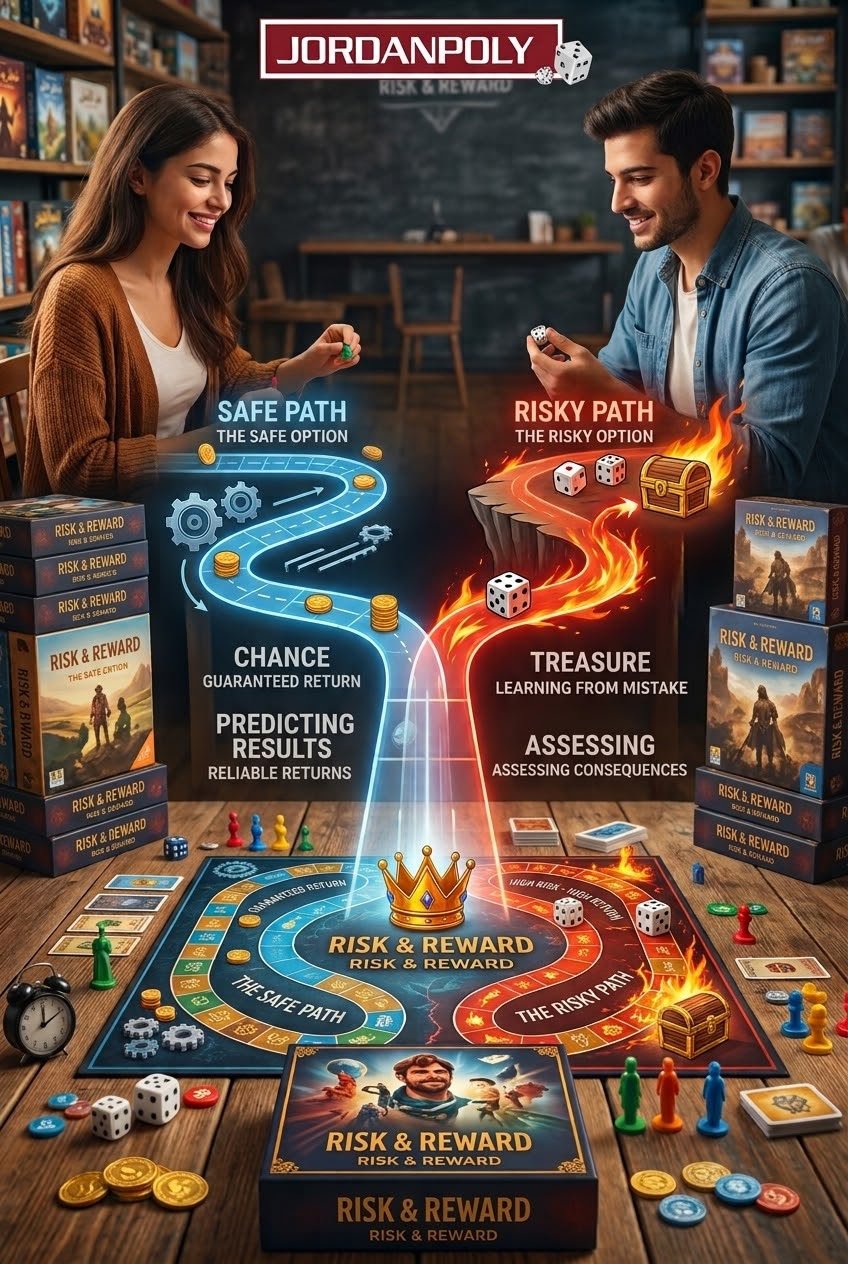
Board games are often seen as a fun way to spend time with friends and family. However, many board games involve something much deeper: decision-making under uncertainty.
Players constantly face choices such as whether to take a safe action, make a risky move, invest resources, trust another player, or wait for a better opportunity. The outcome is not always guaranteed, and that is exactly what makes risk an important part of the board-game experience.
But how do board games change the way we think about risk? And what can players learn from making risky decisions during a game?
What Does Risk Mean in Board Games?
Risk in board games refers to making a decision when the outcome is uncertain.
For example, a player might have two choices:
* Take a safe action that gives them a small advantage.
* Take a risky action that could give them a much larger reward—or cause them to lose valuable resources.
This creates an interesting decision-making process.
The player has to ask:
* What could I gain?
* What could I lose?
* How likely is each outcome?
* Can I recover if the decision goes wrong?
* Is the potential reward worth the risk?
These questions are similar to decisions people make in everyday life.
Why Does Risk Make Board Games More Exciting?
If every decision in a game had a predictable result, the experience could become repetitive.
Risk introduces uncertainty.
A player may have a strong strategy, but an unexpected event can completely change the situation. This creates moments of excitement, tension, and surprise.
Risk can make players think:
“Should I play it safe, or should I go for it?”
That simple question can completely change the direction of a game.
Risk Is Not the Same as Luck
One of the most important ideas in board games is the difference between risk and luck.
Luck happens when an outcome is mainly determined by chance. For example, rolling a die or drawing a random card.
Risk, on the other hand, involves a decision.
A player may know that a certain action has an uncertain outcome, but they still have to decide whether to take that action.
Many board games combine both elements:
Luck creates uncertainty, while strategy determines how players respond to it.
This combination can make games more dynamic and unpredictable.
Risk and Reward
One of the most common concepts in board games is risk versus reward.
A bigger potential reward often comes with a bigger potential risk.
For example, imagine a player can choose between:
* Gaining 2 points with almost no risk.
* Attempting a difficult move that could earn 10 points.
* Failing the move and losing an important resource.
The best decision is not always the one with the biggest reward.
Instead, players need to consider whether the potential reward justifies the possible consequences.
This encourages players to think beyond immediate gains.
Why Do Some Players Take More Risks?
Different players have different attitudes toward risk.
Some players prefer safe and predictable strategies, while others enjoy taking chances.
Risk-taking can depend on several factors:
* The player’s current position.
* The amount of resources they have.
* How close they are to winning.
* How much they could lose.
* The possible reward.
* How much information they have.
* Their understanding of the game’s mechanics.
This is one reason why two players can face exactly the same situation and make completely different decisions.
Taking Risks When You Are Ahead
Being ahead in a game can completely change the way a player approaches risk.
A player who is already winning may prefer safer decisions because they have more to lose.
For example, if a player is close to winning, they may avoid a risky move that could give another player an opportunity to catch up.
This creates an important strategic concept:
Sometimes the best decision is not to take a risk.
Knowing when to avoid risk can be just as important as knowing when to take it.
Taking Risks When You Are Behind
The situation can be completely different for a player who is losing.
When safe strategies are unlikely to help them catch up, taking a calculated risk may become more attractive.
A player might think:
“If I continue playing safely, I probably won’t catch up. Maybe I should try something different.”
This can create dramatic changes in the game.
A risky decision may fail, but it may also create a new opportunity.
Learning to Manage Risk
Board games can help players understand that risk does not always mean acting recklessly.
Good risk management involves thinking about consequences before making a decision.
Players can learn to:
* Evaluate possible outcomes.
* Compare potential rewards and losses.
* Consider the probability of success.
* Protect important resources.
* Avoid unnecessary risks.
* Recognize opportunities.
* Adapt when circumstances change.
These concepts can make the decision-making process more thoughtful.
The Importance of Incomplete Information
Many board games do not give players complete information.
You may not know:
* Which cards another player has.
* What they are planning.
* What they will do next.
* What card will be drawn.
* What the next dice roll will produce.
* Whether another player is preparing an attack or a defensive move.
This incomplete information makes risk much more interesting.
Players have to make decisions using the information available to them instead of waiting for certainty.
Bluffing and Psychological Risk
Some board games introduce another type of risk: psychological risk.
In games involving bluffing, negotiation, or hidden information, players may need to predict what others are thinking.
A player might pretend to have a strong position even when they do not.
But bluffing creates a risk.
If another player recognizes the bluff, the strategy may fail.
This means that players are not only managing game resources—they are also managing information, expectations, and human behavior.
Good Decisions Can Still Produce Bad Results
One of the most valuable lessons that board games can teach is that a good decision does not always produce a good outcome.
Imagine a player makes a decision that has a high probability of success.
The player may still lose because of an unexpected card or dice roll.
Does that automatically mean the decision was wrong?
Not necessarily.
The quality of a decision should be evaluated based on the information available when the decision was made, not only by looking at the final result.
This distinction is important because it helps players understand the difference between:
“I made a bad decision.”
and
“I made a reasonable decision, but the outcome went against me.”
Risk Makes Games More Replayable
Risk and uncertainty can also increase replayability.
If the same strategy always produced the same result, players could eventually stop finding the game interesting.
However, when different decisions can lead to different outcomes, every game can develop differently.
A player may think:
* “What if I had taken the other path?”
* “What if I had taken the risk earlier?”
* “What if I had saved my resources?”
* “What if I had trusted the other player?”
These questions encourage players to play again and experiment with different strategies.
Can Every Board Game Teach Risk Management?
Not necessarily.
Different board games focus on different experiences.
Some games are primarily based on:
* Strategy.
* Luck.
* Negotiation.
* Cooperation.
* Competition.
* Resource management.
* Deduction.
* Bluffing.
* Planning.
Games that include meaningful choices and uncertain outcomes generally provide more opportunities to explore risk.
The important factor is not simply whether a game contains luck, but whether players have meaningful decisions to make in response to uncertainty.
Does the Number of Players Affect Risk?
Absolutely.
The number of players can significantly change the level and type of risk in a game.
With two players, decisions may be easier to analyze because there are fewer variables.
With several players, the situation can become more unpredictable.
A player may have to consider:
* Multiple opponents.
* Different strategies.
* Temporary alliances.
* Changing threats.
* More unpredictable decisions.
As the number of players increases, the amount of uncertainty can also increase.
What Can Players Learn From Risk-Based Games?
Playing board games does not automatically make someone better at every real-life decision. However, games can provide a safe environment where players can practice thinking about uncertainty and consequences.
Players may become more familiar with concepts such as:
* Evaluating consequences.
* Comparing risk and reward.
* Planning ahead.
* Adapting to unexpected events.
* Making decisions with limited information.
* Learning from mistakes.
* Recognizing when patience is valuable.
* Understanding that outcomes are not always predictable.
The game provides a controlled environment where players can experiment with different approaches without real-world consequences.
Risk Is Part of What Makes Board Games Interesting
Risk is one of the elements that can turn a simple board game into a complex decision-making experience.
Players are not simply moving pieces or collecting points. They are constantly asking questions, evaluating possibilities, predicting outcomes, and deciding how much uncertainty they are willing to accept.
Sometimes the smartest move is taking a risk.
Sometimes the smartest move is waiting.
And sometimes a carefully considered decision can still lead to an unexpected result.
That combination of strategy, uncertainty, and decision-making is one of the reasons board games continue to be engaging for players of different ages and experience levels.
Whether you enjoy strategic games, competitive games, cooperative games, or games based on luck and probability, understanding risk can make the experience even more interesting.











Leave A Comment